
Partnership Accounting
Family office accounting is all about how families invest and, on the backend, how that investment activity flows through the books. SumIt's partnership accounting module tracks ownership structures as they evolve, and allocates income and expenses to the right partners automatically.
From partnership setup to consolidated reporting, SumIt provides a clear path through your allocation workflow.
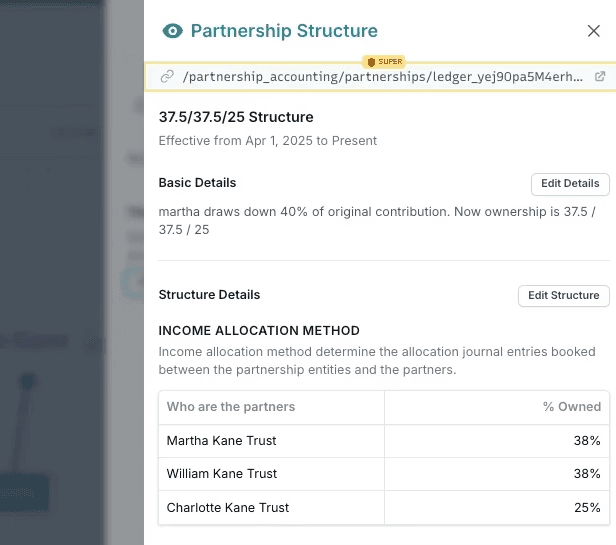
One place to tell the system what each partnership is.
Before any allocation can happen, the system needs to know the structure. In SumIt, you define each partnership between entities, set the allocation method, and specify each partner's ownership percentage.
Because ownership changes over time, you can configure different allocations for different time periods.
The system always reflects the current structure, and historical records stay intact.

Decide exactly how allocations are booked.
SumIt gives you control over the accounting treatment for each partnership. You choose whether realized gains should be separated from unrealized gains when booking partnership income, and you select which general ledger accounts are affected by each allocation.
These settings determine how the change in value flows across partners, so the output matches the way your office prefers to report.

Allocate retained earnings to the right partners.
Once your partnership is configured, SumIt handles the allocation work. For any given time period, the module distributes income and expenses to each partner according to the settings you defined.
A built-in timeline view shows you what has been allocated, what is pending, and what still requires attention.

All of the logic, reflected in every report.
Partnership accounting is only as useful as the reporting it produces. In SumIt, the allocation logic carries through to your net worth statement, income statement, and entity map. As ownership percentages change over time, the entity map updates accordingly.


Sophia Franco
CFO, Point North Capital
Do I need to manually book journal entries for each allocation?

No. SumIt's allocation module generates the journal entries automatically based on your partnership settings. You can review them before they're posted, but the system handles the preparation.
Can I track changes in ownership percentages over time?

Can SumIt handle complex allocation scenarios like waterfall distributions?
Which reports reflect partnership accounting data?
Can I choose which accounts are affected by each allocation?
Try SumIt Today
Modernize Your Back Office, Today.
Talk to us to learn more about SumIt and we will help you evaluate our platform. We care about your success and can help you find out quickly if SumIt can be a good fit.